Tesla Model 3 vs Toyota Camry: Which Is Cheaper to Own? (2026)
The Toyota Camry is the default midsize sedan — reliable, efficient, and now hybrid-only — while the Tesla Model 3 is the electric car that finally made EVs mainstream. They're the two cars millions of buyers actually cross-shop. Here's an honest look at how they compare on price, running costs, and the things that don't show up on a spec sheet.
Sticker price: the Camry starts lower
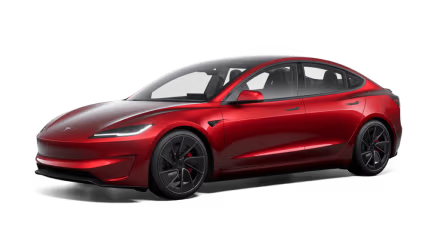
There's no getting around it — a Camry is cheaper to buy. Today's Camry is hybrid across the board and starts in the high-$20,000s, with a loaded XSE all-wheel-drive version landing around $37,000. A Model 3 Long Range AWD runs about $47,490. So a comparably-equipped, all-wheel-drive pairing puts the Tesla roughly $10,000 higher up front, and an entry Camry stretches that gap further. The Model 3 starts to claw that back the moment you start driving.
Fuel: this is where the Tesla wins big
The Camry hybrid is genuinely efficient — about 43–51 mpg depending on trim — which is excellent for a gas car. But the Model 3 is in another league on energy cost: charging at home, it's the equivalent of paying a fraction of the per-mile cost of gasoline, typically just 4–6 cents a mile versus roughly 8–9 cents for even a thrifty hybrid. Over 12,000–15,000 miles a year that difference adds up to hundreds of dollars annually, and it grows the more you drive. Estimate your own number in our charging cost calculator.
Maintenance: advantage Tesla
Toyota hybrids are famously durable and cheap to service, but a Camry still needs oil changes, eventual brake jobs, and the usual gas-car upkeep. The Model 3 has no oil changes, no spark plugs, no transmission service, and regenerative braking that makes brake jobs rare. Both are cheap to maintain by car standards; the Tesla is cheaper still. See the real list in our Tesla maintenance schedule.
Where the Camry still makes sense
- Lower price to get in — if upfront cash is the priority, the Camry wins.
- No charging logistics — if you can't charge at home and don't want to think about it, gas is simpler.
- Legendary reliability and resale — the Camry is one of the safest long-term bets in the business.
- Long road trips with no planning — five minutes at any gas station, anywhere.
Where the Model 3 pulls ahead
- Far cheaper to fuel and maintain — the running-cost gap is the Tesla's whole argument.
- Performance and tech — instant torque, a quicker 0–60, and over-the-air updates that keep improving the car.
- Home "refueling" — you plug in at night and never visit a station for daily driving.
- Insulated from gas prices — your "fuel" cost is your home electricity rate, not a pump price that swings with the market.
So which is cheaper to own?
It comes down to two things: how many miles you drive and your local fuel and electricity prices. The Camry's lower sticker — and its class-leading resale, since Toyotas hold value exceptionally well — means the Tesla has a gap to close; the Model 3's much lower running costs close it over time, usually within a few years for a typical driver — sooner if you drive a lot or gas is expensive where you live, later if you barely drive. Our depreciation estimator folds the Model 3's steeper resale curve into that math, so the calculator's break-even already accounts for it. Rather than guess, run both through our Tesla vs gas cost calculator — it's preloaded to compare exactly this Model 3 against this Camry, with your state's gas, electricity, insurance, and fees, and shows the year the Tesla pulls ahead.
If you land on the Model 3, ordering through a referral link can add Tesla’s latest new-buyer perk — a no-cost bonus on a new car.