Tesla Full Self-Driving Will Now Overtake Manual Driving to Avoid Disaster
The new active safety layer in FSD v14.3.9 can execute coordinated evasive maneuvers when automatic emergency braking is insufficient.
Tesla is beginning to roll out Full Self-Driving (Supervised) v14.3.9, a software update that introduces a new active safety layer capable of taking control of the vehicle even when the driver is operating it manually.
What Happened
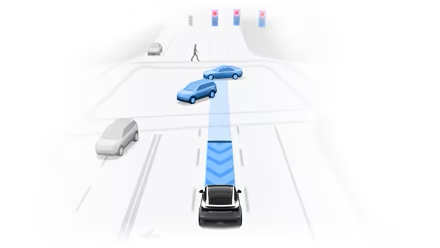
According to Tesla AI, the new software can activate FSD on the driver’s behalf when an imminent collision is detected and Automatic Emergency Braking (AEB) may not be enough. The system may also engage if it detects heavy distraction, such as a driver reaching toward the back seat, or if it identifies an accidental disengagement of FSD. Unlike conventional AEB, which primarily applies brakes in a straight line, this feature—described as Automatic Collision Evasion—can utilize steering, braking, and acceleration together. If the car calculates that stopping alone will not prevent impact and a safer path exists, it may change lanes or move toward a shoulder before continuing to drive after the immediate threat is resolved.
Why It Matters
This update addresses a critical failure mode in current driver-assistance systems: the gap between detecting a hazard and successfully avoiding it when braking is insufficient. By allowing FSD to intervene during manual driving, Tesla creates a background safety net that leverages the vision stack already present in v14. This is particularly relevant for preventing collisions caused by last-second distractions or accidental FSD disengagements, such as a minor steering nudge. However, Tesla continues to frame FSD as supervised assistance; the intervention is intended as a last-resort measure, not a replacement for attentive driving. Drivers remain responsible for the vehicle, and the feature requires an active FSD purchase or subscription.
The Bottom Line
FSD v14.3.9 transforms Full Self-Driving from a feature that is only active when turned on by the driver to a potential emergency safety net that can act during manual operation. While this marks a significant step in autonomous safety capabilities, Tesla has not published data on intervention frequency or false-positive rates, and the vehicle remains unsupervised only in specific emergency contexts.