Tesla Patents Vision-Based Lane Connectivity System Using Autoregressive Transformers
The system tokenizes road coordinates and predicts lane paths using an inference loop, treating intersections like sentences to be read.
Tesla has been granted a patent describing how its Full Self-Driving system maps complex lane connections using an architecture borrowed from large language models, eliminating the need for high-definition pre-mapped roads.
What Happened
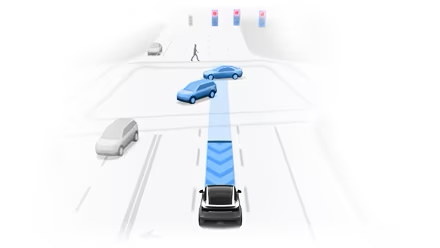
Patent US 2026/0170852 A1, titled 'Vision-Based Machine Learning Model for Lane Connectivity in Autonomous or Semi-Autonomous Driving,' reveals how Tesla's FSD processes multi-lane intersections. The system converts camera pixels through backbone networks into a bird's-eye view vector space, then applies autoregressive transformers that tokenize road coordinates and predict subsequent spatial points along a driving path. The network runs between 64 and 108 inferences per cycle to complete each lane before resetting for adjacent lanes. A video queue module acts as temporal memory, preserving historical feature maps to maintain predictions when lane markers are occluded by vehicles or debris. Standard map data is used only as a hint and can be overridden with a 'don't know' signal if deemed unreliable.
Why It Matters
For Tesla owners and prospective buyers, this patent demonstrates how FSD handles scenarios where traditional mapping approaches fall short. Rather than relying on brittle HD maps like competitors Waymo and Zoox, the system reads intersections in real time through visual reasoning alone. This approach scales globally without region-specific mapping updates. The architecture ensures continuity when lane lines disappear under large trucks or construction debris, directly addressing a common failure point in autonomous driving.
The Bottom Line
Tesla's patent shows FSD no longer just processes images—it actively interprets road geometry by applying language model techniques to spatial data, treating lane connections as structured sequences the network learns to complete like sentences.